Team. I led the build alongside Diogo from Okra's Product team and Affy, Okra's CEO. Together we shaped the product, operating model and first workflows.
Status. Running on Okra's infrastructure and currently in beta.
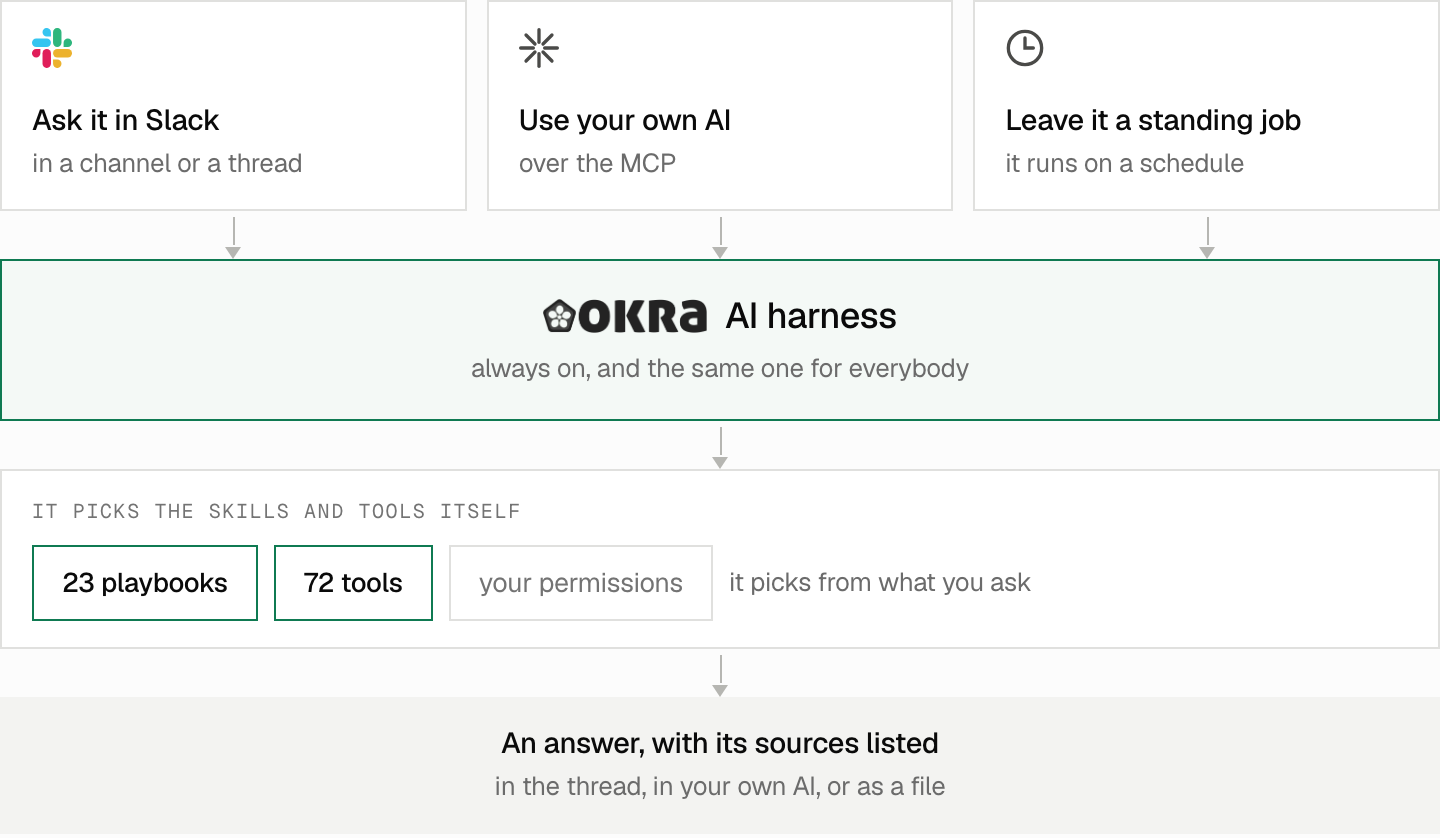
An early-July workshop with Okra team leads exposed the gap. People could improve their own prompting and set up personal connectors and automations. They still lacked the shared context, live data, tools, playbooks and connectors used by the power users.
The problem with personal agents
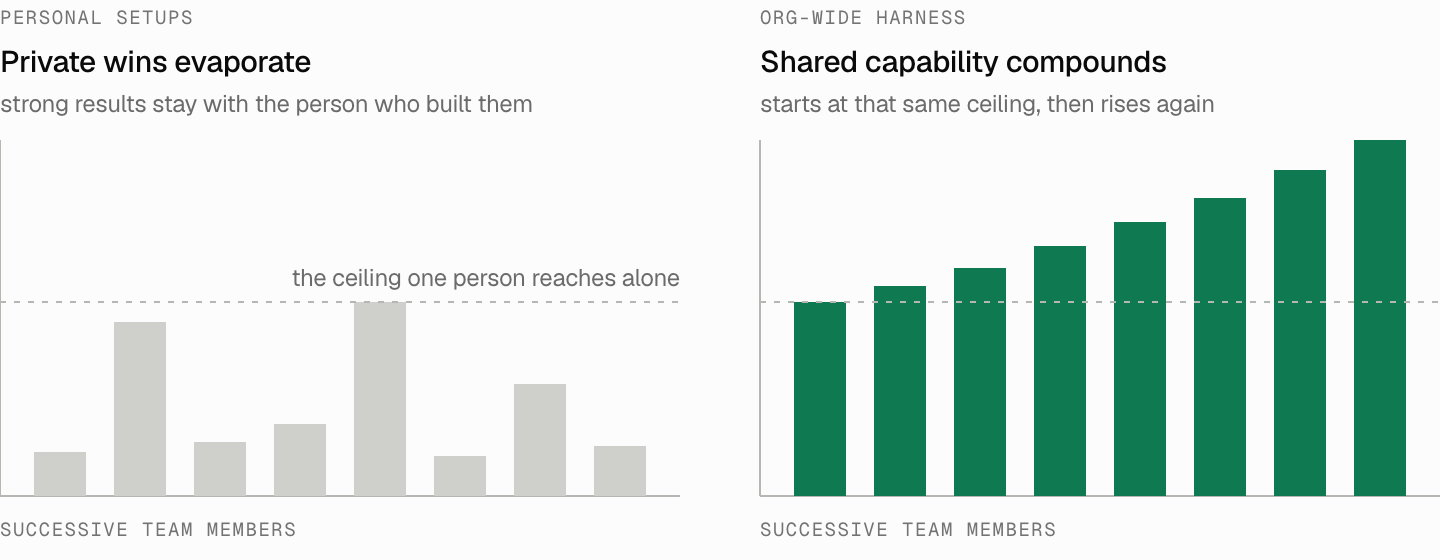
Personal AI setups can be individually excellent and organizationally limited. Paradigm's team, building Centaur, reached the same conclusion: personal agent stacks break down when work is collaborative. They need you present, other people struggle to reuse what you built, and giving everybody credentials to real systems is risky.
A reliable method for reviewing a customer account can live in one person's chat history or personal skill. A correction improves one conversation and dies there. The next colleague re-derives the same context or receives the stale answer with full confidence. The people already ahead pull further ahead while their wins stay private by construction.
“Models change quickly, but a company's tools, data, permissions and shared history shouldn't have to change with them.”
If the valuable thing is a combination of context and agentic workflows, it should become organizational infrastructure rather than forty private configurations.
What we built: one baseline, two doors
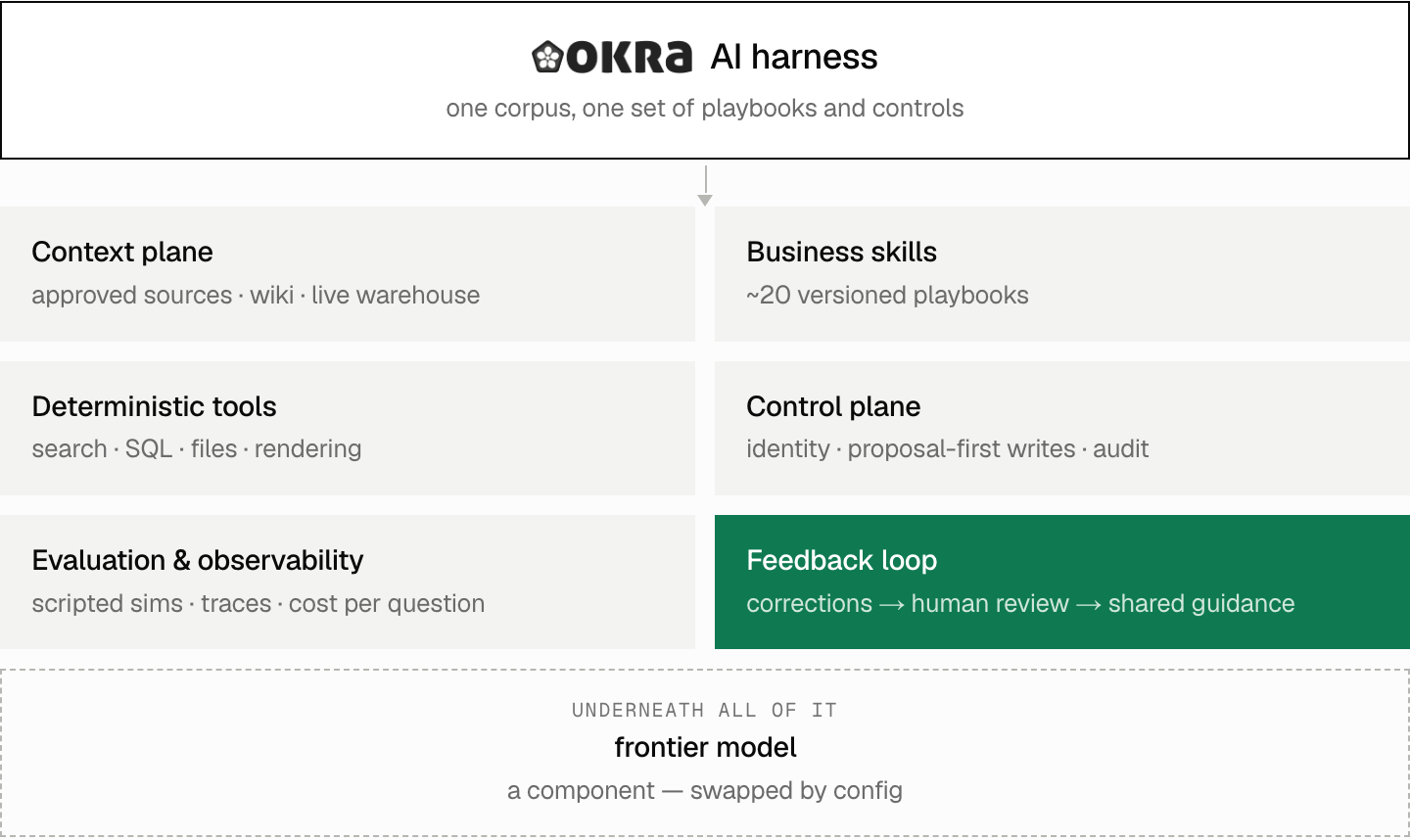
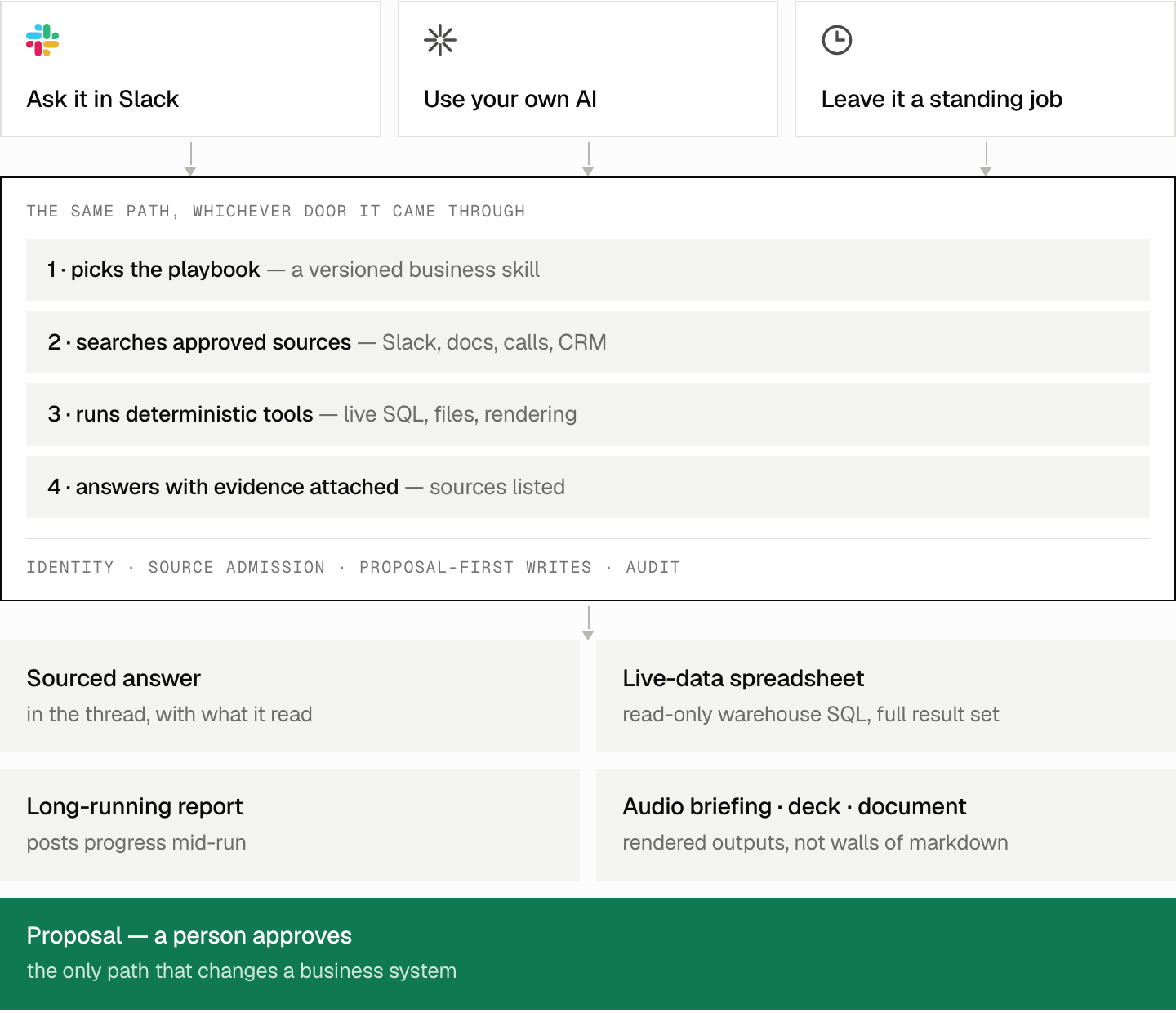
The harness gives the whole company a maintained baseline for agentic work: approved knowledge from internal tools, live read-only warehouse queries, versioned playbooks, tools for search, data, rendering and delivery, and the accumulated corrections of the people who used it before you.
Two doors reach it. People can interact with the bot in Slack or connect their own AI client over MCP and retain their preferred interface. Both routes reach the same governed knowledge base and versioned business logic through lane-specific tools and controls.
The output varies by job. It might return a sourced answer in a thread, a spreadsheet or chart, a long-running report, an audio briefing, a deck, or a proposal for a named person to approve. Standing jobs can run in the background without somebody keeping a laptop open.
On a real job
In early August, Affy spent about an hour encoding his business-review expertise into a playbook. The harness combined those rules with CRM records, call transcripts, documents and live warehouse queries. In one 20-minute run, it made 34 tool calls and produced five actionable recommendations to improve the customer's end-user experience and ARPU. Affy estimated that collecting the same evidence manually would normally take at least a day. The publishing flow keeps the evidence and later corrections together in one shared, reviewable system.
“Normally, a business review would require deep-focus time from some of the most experienced team members at Okra, combining an understanding of end-user behaviour, seasonal trends, the functionality and limitations of the technology, and the capacity to query our databases. The unfortunate outcome is that reviews would simply not be done because those people are usually busy with the next product iteration or onboarding manufacturers.
“With the MCP, we spent a couple of hours codifying our insights. These rules became a skill that any team member can call in Claude or directly in Slack. A customer success manager can now generate a business review within 30 minutes, evaluate what is actionable, and spend their time delivering the review and getting results in the real world rather than wrangling the data.
“More business reviews have been delivered in the last month than in the last year, and end-user top-ups and consumption are up by over 20% as a result.”
Why it compounds
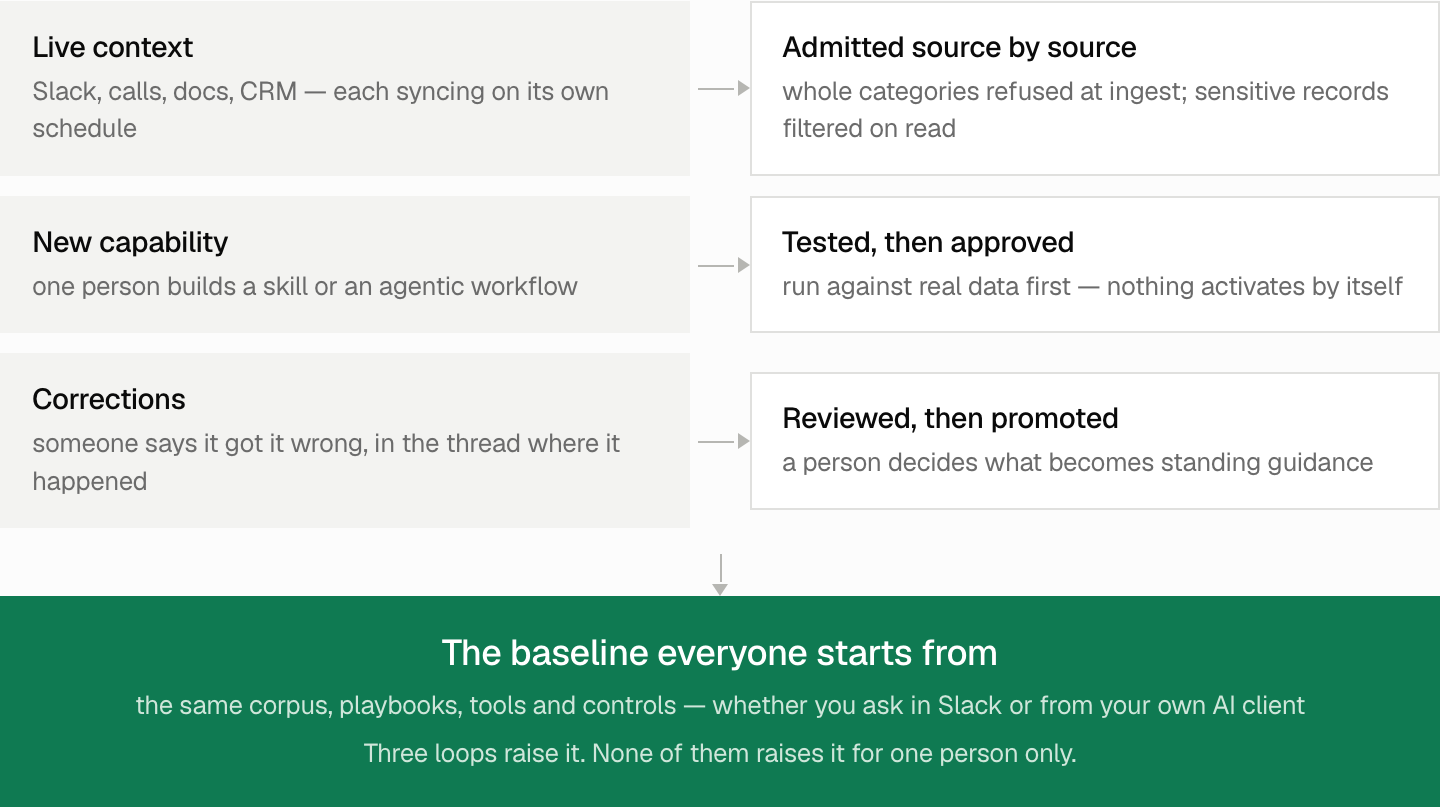
A shared agent is only worth the trouble if it improves through work the team already does, without every improvement becoming a separate engineering project. It still needs owners, operator decisions and maintenance.
Company activity becomes retrievable context. The harness reads admitted sources such as Slack, meeting transcripts, documents and CRM records. Material requiring person-specific visibility stays outside the shared corpus.
One person's workflow can become a shared capability. A workflow can be tested against real data, reviewed and made available to approved colleagues. Useful methods no longer have to remain in one person's chat history or configuration.
Corrections can become standing guidance. A single correction remains a candidate. Corroboration from distinct people or explicit operator approval can promote it into shared guidance. Skill code, pull requests and production changes still pass through human review.
This creates a portable, durable asset: a company-owned corpus, playbooks, permission decisions and reviewed corrections. Models and runtimes may change while the operating layer above them continues to evolve.
Diogo described what the shared harness changes for the wider team:
“Most of the Okra team are busy and don't have the time to optimize their own local Claude setup. I had already seen the value of working with rich, self-updating context and targeted connectors in my own set up. Building the org wide harness alongside Matt has allowed us to share that superpower with the wider team.
“Within a few weeks, people who wouldn't ordinarily set up local context or even open Claude Code were using Okra AI to produce work that has already reached customers and changed how they use our technology.”
What it can't solve
The harness can search the approved corpus and query connected data, but it cannot recover knowledge that was never recorded. When sources disagree, the agent inherits that ambiguity. Unclear or stale documentation can affect every run that relies on it.
The tech stack
The system is built on NanoClaw, an open-source, MIT-licensed agent runtime with container-isolated execution and a message-only boundary between host and agent. We extended it with Okra's connectors and source-admission controls, versioned business skills, output formatting and delivery, authenticated MCP access with rate limits, proposal-first controls by default, audit, evaluation and production operations.
Where this goes
The next step is an agentic layer that monitors company streams and drafts follow-up for named owners. It could flag a stalled deal, a stale tracker, or a drop in village consumption between meetings. Reliability and attention remain the constraints. Specific workflows and knowledge need owners, with proposal-first authority by default.
A first version is already live for small app experiments. A dedicated container can change one private sandbox app and produce a preview or pull request without credentials to Okra's production repositories or business systems. Most ideas can stop there. Promising ones can become durable assets that the team can inspect, correct and reuse. The sandbox lowers the cost of experimenting, not the standard for shipping.
I work with teams on organization-wide AI harnesses, applied LLM systems, and the product infrastructure around them.